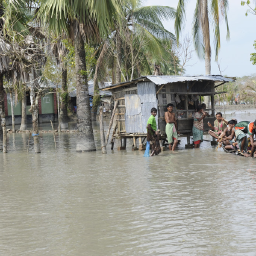
We study how tools from algorithmic decision, machine learning, and causal inference can help us measure and identify the effects of environmental degradation and propose new pathways to more sustainable societal development. We will discuss how market design can be helpful when thinking about carbon bonds or biodiversity conservation, as well as how we can use a combination of ML and causal inference to identify adaptation policies to a changing environment.
Fall 2020 - Spring 2021. The Asia-Pacific group covered a range of topics, with meetings scheduled for participants in these time zones.
Some of the topics the group will work on include but are not limited to free speech, content moderation, antitrust, the use of “black box” machine learning models, data-driven algorithms, and decision-support tools.
Concluded Fall 2021. We work to better understand issues of bias, discrimination, and fairness that arise when technological systems are deployed in social and economic environments.
Concluded Fall 2022. We study the mathematical theory of civic participation, focusing on novel modes of democratic decision making that complement traditional elections.
Concluded Spring 2022. The data economies and data markets working group aims to better understand the challenges that arise across the data pipeline from creation, ownership, accessibility, and sharing to data analysis and use.
Concluded Fall 2022. We study how techniques from algorithm and mechanism design, computational social science, and optimization can inform and help advance existing development policies and practices.
Concluded Spring 2022. This group focuses on different research areas, such as understanding the impacts of ranking problems and design of resource allocation mechanisms.
Concluded Fall 2022. We study how computational methods can help address environmental challenges, particularly those that exacerbate the climate crisis.
Fall 2018 - Spring 2020. We are a group of academic researchers working on real world healthcare market design problems (e.g. kidney exchange, risk adjustment) using techniques from computer science, operations research and economics.